Julian's extended reign stabilizes civic pagan statecraft
Julian's survival and long rule allow the Republic to institutionalize classical religion, administrative continuity, and an educated elite loyal to public cult and republican memory.
Lycan historical memory describes a republic that did not vanish with antiquity but changed shape across crises, reconquests, industrialization, and strategic modernization. The official narrative emphasizes adaptation without constitutional surrender.
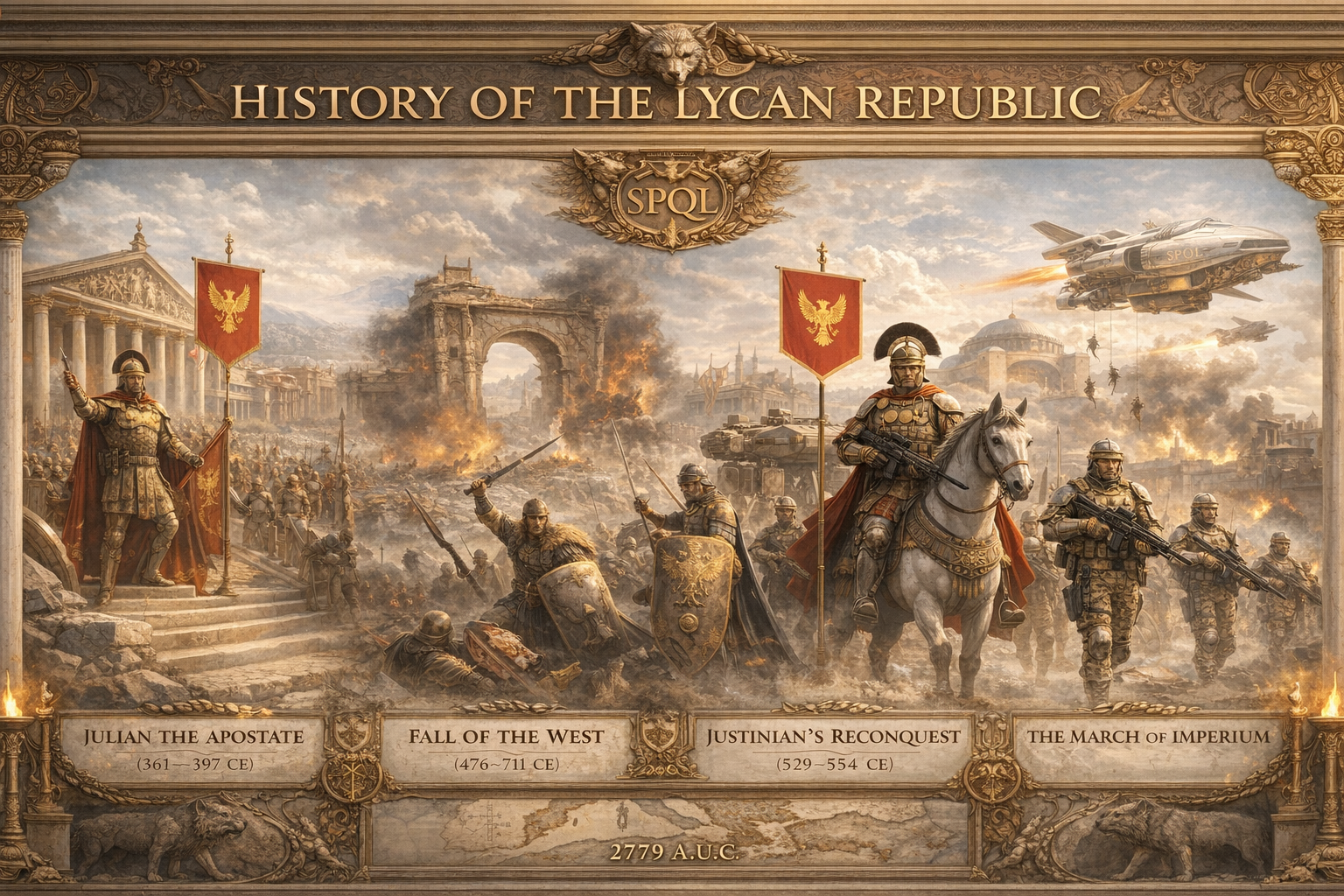
Official history does more than recount events. It explains why the Republic trusts durable offices, military readiness, and disciplined social order over cycles of idealism and collapse.
Founding mythology ties the Republic to Roman inheritance and lupine symbolism, but the political meaning is practical rather than mystical. The wolf marks continuity, collective strength, and the refusal to dissolve under pressure.
Later centuries reinforce the same theme. Losses in the west, pressure in the east, reconquest of Italia, and modern strategic competition are all presented as tests that rewarded institutional patience over improvisation.
This timeline distills the longer national chronology into the public milestones most relevant to the current constitutional story.
Julian's survival and long rule allow the Republic to institutionalize classical religion, administrative continuity, and an educated elite loyal to public cult and republican memory.
Britannia, Gaul, and much of Iberia fall away over time, while the eastern provinces, Egypt, and the Levant preserve the core strategic structure of the state.
The Republic contains collapse but cannot defend every theater at once. Italia becomes the defining trauma that later generations seek to reverse.
With the Balkans secured, Basil's campaigns retake the ancestral heartland and restore the political prestige of western recovery without erasing the Republic's eastern character.
Internal contest over succession and authority resolves in favor of a more clearly republican but still hierarchical political settlement.
The Republic navigates European disorder, maritime competition, and modernization while preserving its own legal and social vocabulary.
Postwar rearmament links orbital capability, advanced energy systems, and strategic industry into the modern image of Lycan power.
In current official framing, continuity, supply security, and institutional memory remain the strongest answers to geopolitical disorder.
The Republic does not describe its past as a chain of endings. It describes a succession of recoveries.
Public historical summary